AXION
Autonomous and Isotropic Mobility Architecture for Civilizational Resilience.
THE URBAN
SPACE-TIME CRISIS
The origin of this object is not born from an aesthetic search, but from a necessity of systemic human survival. Contemporary cities have entered a phase of critical entropy:
Collapse by Density & Traffic
Saturated road infrastructure that congests the movement of the human mass and wastes millions of hours of life in inefficient journeys.
Outdated Mobilization Systems
Transport matrices designed in the 20th century on a rigid logic of asphalt, traffic lights, static lanes and large-volume vehicles that no longer respond to the dynamics of current space.
Inability to Respond to Crisis
Centralized urban infrastructure that lacks resilience and adaptability in the face of massive displacements or network failures.
THE TECHNOLOGICAL VECTOR: AI AS A PROPULSIVE FORCE
In this scenario, artificial intelligence and emerging technologies are not optional tools; they are a tectonic force that inevitably pushes us to redefine physical existence. New technologies have accelerated the pace of civilization, exposing the fragility of the past’s physical structures. We cannot respond to the speed of the algorithmic era with rigid metal containers from the previous century.
The first wave of automation (Tesla, Waymo) tried to solve the problem by digitizing only the software, while leaving the form intact. AXION was born from understanding that artificial intelligence demands a new physical morphology to reorder human mobility in space-time.
AI is not just the “brain” of the vehicle — it is the civilizational engine that forces us to redesign the entire architecture of our objects.
THE FOUNDATIONAL
QUESTIONS
Every model project begins with one important question that directs action toward the survival of the human species. Others follow — we show them here.
Because keeping a 4.5-meter elongated container on asphalt to move a single individual is an unacceptable inefficiency in a collapsed space.
Because they depend on rigid road infrastructure and centralized maps that collapse in the face of systemic crises:
Inability to Shelter
A conventional car is only a static transport machine when it stops. If the city collapses, it provides no filtered air, no closed-cycle energy, no bioclimatic thermal regulation, no biometric integration with the user’s body.
Extreme Dependence on the Central Network
If road infrastructure fractures or the power and fuel supply is cut, the traditional vehicle becomes a useless metal container — a spatial trap.
Biological Vulnerability
Instead of being a life-support capsule that preserves the individual’s physical and psychological health, the traditional car exposes the human to traffic stress, environmental pollution and assistive isolation.
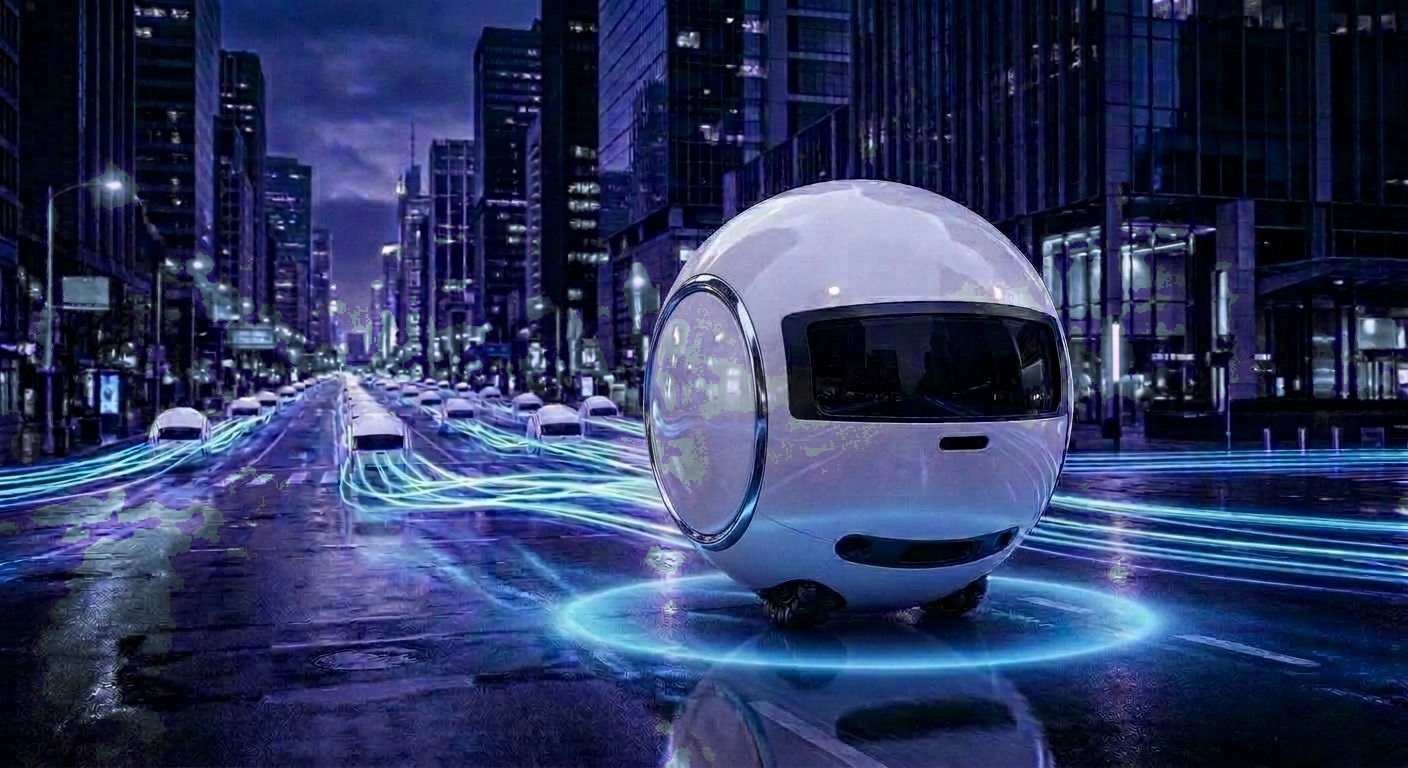
By redesigning mobility from first principles: replacing the elongated mass with a spherical, isotropic module operated by edge AI.
Designed as an umbilical survival module for the human being — guaranteeing mobility, biometric protection, energy and continuous shelter in the face of environmental collapse.
THE IMPORTANCE
OF THE FORM
The design of this model exists in several versions with small modifications — each with the capacity to give its passengers different immersive experiences. A matter handled by the Yanina Vallejos Technology division (yv-technology.com). What is relevant now is not the aesthetic design, but the form of the model and its importance — answering why it exists and the importance of the form. Because this spherical, isotropic design makes sense:
Omnidirectionality
Its geometric architecture allows it to rotate on its own axis and move along any vector of the plane with zero turn radius — eliminating complex maneuvers and reducing the road space required to the mathematical minimum.
Integrable Isotropic Module
By abandoning the hood and the trunk, the volumetric mass is used at 100% for human habitability and life support.
Terrestrial–Aerial Transition
Its spherical, symmetric chassis is aerodynamically optimized to interact with aerial elevation and propulsion platforms in advanced phases of mobility.
It is the physical answer to navigate the human transition after urban collapse — guaranteeing displacement, energy and symbiotic connection with the Habitat Object (MODEL: AETHER / HOME) and the biometric interface (MODEL: SYNAPSE / PRODUCT).
THE EVOLUTION OF AXION MOBILITY
The present model is only the beginning of a vision that has taken form and route. Its evolution in technological architecture and design belongs to the Yanina Vallejos Technology development division — yv-technology.com.
AXION stops being a “means of transport” to become the dynamic module of the new life infrastructure:
Terrestrial Contact
The sphere uses a system of omnidirectional / spherical contact wheels integrated into the base of the spherical body.
Movement on asphalt or flat surfaces of current infrastructure without body turns — immediate physical stability as the urban transition begins.
Reduced Contact
Reduction of physical contact through inductive propulsion / electromagnetic levitation over adapted surfaces.
Terrestrial–Aerial
Total decoupling from the ground through autonomous aerial sustentation — convertible into a flying module.
THE SPACE-TIME
ROADMAP
To transform this vision into a high-return financial asset, AXION deploys along a space-time line divided into three commercial phases — with scaling cycles of 18 to 24 months per phase.
Urban MaaS Insertion
Immediate cash flow.
Smart Districts
Leasing & AETHER coupling.
Global Civilizational Network
Sovereign global membership.
Urban Insertion & Decongestion
Deployment of functional prototype fleets (spherical capsules) within current urban infrastructure, under the MaaS model (Mobility as a Service).
Premium robotaxi service and point-to-point micro-transit in high-density corridors. Spherical compactness allows doubling passenger density in the same road footprint.
Fare income, real-time biometric traffic data monetization, and government / private contracts for urban congestion relief.
Smart Districts & Eco-Communities
Establishment of mobility monopolies in private real-estate developments, corporate campuses, airports and planned communities.
Corporate fleet sales and leasing, and integration licenses direct with the Habitat Object (AETHER) and remote-work platforms.
Global Civilizational Network
Transition to autonomous aerial sustentation and total energy sovereignty.
Global unlimited-access memberships to the transport, energy and data network of the NEXUS-V Ecosystem.
VULNERABILITY MATRIX &
SYSTEMIC MITIGATION
Instead of ignoring technical barriers, AXION integrates the mitigation of failure vectors from the origin architecture — offering a transparent, mature posture for the investors’ due diligence process.
| Model | Critical Failure Vector | Mitigation Strategy in AXION |
|---|---|---|
Waymo Benchmark | Extreme dependence on HD maps, Lidar and rigid geofencing. | Independent Edge AI: adaptive vision navigation and local sensory processing, with no mandatory fixed maps. |
Tesla Benchmark | Pure vision on a traditional chassis; saturation in road edge cases. | Spherical Isotropic Geometry: elimination of the maneuver concept and reduction of spatial friction to 0°. |
AXION Self-vector | Regulatory friction: road norms written for four-wheeled vehicles with a steering wheel. | Initial B2B Deployment (Points A/B): operation in closed districts, campuses and privately-regulated eco-communities before public opening. |
AXION Self-vector | Network dependence (V2X): loss of flow advantages if initial fleet density is low. | Redundant Edge-to-Synapse Processing: each unit operates as an autonomous biometric decision node even if the central network falls. |
AXION Self-vector | Mechanical wear: kinematic stress on the spherical omnidirectional traction. | Plug-and-Play Modules: rapid replacement of the rolling layer without disassembling the vehicle structure or chassis. |
AXION Self-vector | Cybersecurity: risk of attacks on the fleet orchestration network. | Decentralized Consensus (NEXUS-V): local validation of the trajectory, linked to the intention expressed by the SYNAPSE interface. |
THE TRINE
ECOSYSTEM
AXION is not an isolated vehicle; it constitutes the circulatory network of the trine ecosystem authored by Yanina Vallejos:
AXION
SYNAPSE
“As a business model designer and systems architect, my faculty lies in observing, conceptualizing and projecting the multiple possibilities of existence for human life in the face of urban entropy. YANINA VALLEJOS — AXION represents one response within an ecosystem of integrated artificial intelligence (NEXUS-V); yet this is only one of my portfolio models for mobility. In parallel, I have contemplated and designed alternative ecosystem models without AI intervention — based on classical thermodynamics, physical sovereignty and analog biomechanics (RAIZ-TERRA) — to guarantee that humanity always keeps the freedom to choose the form in which it wishes to sustain its future.”

Design, theoretical framework, mitigation matrix and systems architecture developed by Yanina Vallejos. Published at www.yv-technology.com. All rights reserved over the integration of the NEXUS-V Ecosystem.