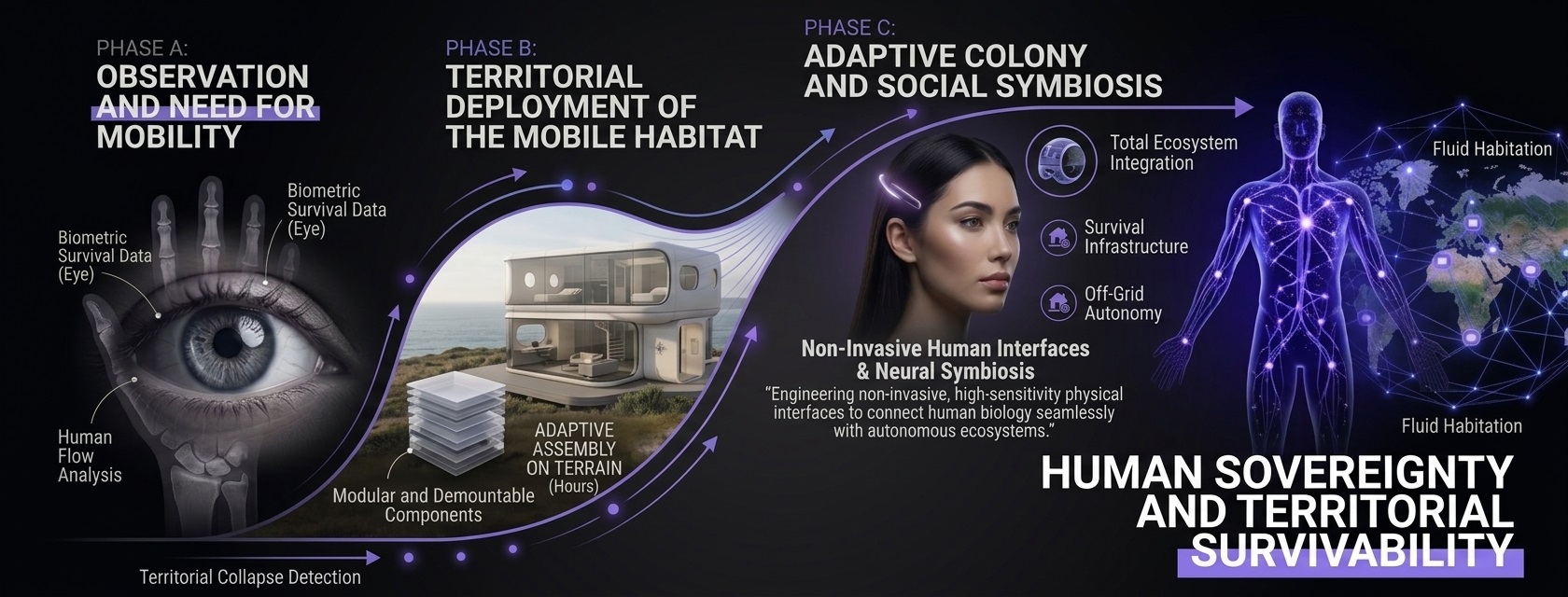
QDT + AGI = META-DESIGN

This space exists to document, build, and expand a new operating model for design, intelligence, and system creation.
Here, I explore how human architectural thinking and artificial intelligence converge to design scalable systems, business models, and new categories of value.
This is where methodology becomes infrastructure. And where ideas become operational frameworks.

QDT provides judgment, structure, and a systemic view.
AGI provides computation, simulation, and general learning.
The Metadesign Engine generates new organizational, technological, and economic realities. – Yanina Vallejos

Welcome to the Era of META-DESIGN
QDT + AGI

Where human architecture meets artificial general intelligence to create scalable systems and new forms of value.

What is Meta-Design?

Meta-Design is not about creating isolated products.
It is about designing the systems, architectures, and intelligence frameworks that generate products, services, and entire new markets.

In this era, the goal is no longer to build one solution.
The goal is to design the engine that creates many.
In a world shaped by artificial intelligence, fragmented thinking is no longer competitive.
Systemic thinking is.

A New Operating Model for the Future

To design at scale, organizations need more than creativity.

They need a framework capable of:

  • understanding complexity,
  • redefining structures,
  • integrating intelligence,
  • and executing across evolving environments.

This is where QDT and AGI converge.

QDT + AGI

WHAT DOES THIS UNION MEAN?

The integration of human systems intelligence and artificial general intelligence to design, evaluate, and run large-scale systems.

QDT + AGI = Metadesign Engine

WHAT DOES THIS EQUATION MEAN?

QDT provides judgment, structure, and a systemic view.
AGI provides computation, simulation, and general learning.
The Metadesign Engine generates new organizational, technological, and economic realities.

To understand the future of innovation, we must first understand the two forces that shape it.
One expands human capacity to design systems.
The other expands intelligence beyond traditional boundaries.
Both are complementary capabilities, and their interaction defines the next stage of creation.

The comparison that follows is not theoretical. It is the structural foundation of this work.- Yanina Vallejos

Two Forces. One New Capability.

Quantum Design Thinking and Artificial General Intelligence represent two distinct but complementary forms of intelligence.

One defines direction.
The other expands capability.

Understanding their differences is essential to understanding their power together.

DIMENSION QDT (Quantum Design Thinking) AGI (Artificial General Intelligence)
Core Nature Human cognitive framework Artificial general-purpose intelligence
Primary Function Define structures and direction Solve tasks across domains
Unit of Work Systems, architectures, models Problems, objectives, datasets
Starting Point Ambiguity, gaps, structural voids Available information and learned patterns
Method Deconstruction + selection inference + optimization
Output Blueprint / architecture execution / solution
Relationship to Possibilities Configures scenarios Explores scenarios
Strategic Role Decide what should exist Determine how it can be achieved
Dependency Human judgment computation + training
Scale Strategic and conceptual operational and analytical
Limitation Human bias / finite attention misaligned goals / objective dependency
Competitive Advantage Direction Capacity
Innovation Style Structural reconfiguration accelerated generation and adaptation
Decision Model Conscious selection probabilistic evaluation
Time Horizon Long-term system design short- to mid-term execution cycles
Value Creation New frameworks and architectures scalable intelligence and automation
Failure Mode overconfidence / blind spots optimizing the wrong objective
Best Use Case designing what does not yet exist scaling what is computationally possible

Core Distinction

QDT asks:
What system should exist?

AGI asks:
How can it be built, optimized, or executed?

Combined Equation

QDT = Direction
AGI = Capability
QDT + AGI = Scalable System Creation

Before delving into metadesign, it’s necessary to understand how design methodologies evolve when the magnitude of the challenges changes.

What once worked for products and services becomes insufficient when the objective is to redesign ecosystems, institutions, and interconnected systems.

That transition requires a different mental model. One that does not stop at solving visible problems, but addresses the structures that generate them. This is where Quantum Design Thinking operates. Not as a replacement, but as an expansion of design itself. – Yanina Vallejos

FROM DT TO QDT

The Evolution of Design Methodologies

Design Thinking emerged as a human-centered methodology focused on solving problems through empathy, ideation, prototyping, and iteration.

It transformed industries by shifting design from aesthetics to problem-solving.

For decades, it became the standard for innovation.

But as systems grew more complex, products became interconnected, and organizations required large-scale transformation, a new limitation appeared:

Design Thinking was highly effective at creating solutions — but less equipped to redesign the systems behind them.

That shift gave rise to Quantum Design Thinking.

QDT expands the scope of design from products to architectures, from user needs to system structures, and from iteration to strategic configuration.

It does not replace Design Thinking.
It extends its horizon.

DESIGN THINKING QUANTUM DESIGN THINKING
Human-centered System-centered
Solves problems Redesigns structures
Focus on products/services Focus on architectures/ecosystems
Iterative refinement strategic configuration
Empathy-driven structural intelligence
Prototype solutions define scalable systems
Short- to mid-term impact long-term transformation

Conclusion

Design Thinking taught organizations how to innovate. Quantum Design Thinking teaches them how to redesign the systems of innovation itself.

At the same time, artificial intelligence is also undergoing a transformation.

What began as tools for automation is evolving into systems capable of reasoning, learning, and operating in diverse domains. Understanding this evolution is fundamental.- Yanina Vallejos

FROM AI TO AGI

The Evolution of Artificial Intelligence

Artificial Intelligence began as a set of tools designed to automate specific tasks — recognizing patterns, processing data, and generating outputs.

Over time, these systems became increasingly capable, giving rise to generative AI: models that can create text, images, code, and media.

This marked a major leap in creativity and productivity.

Yet most AI systems remain narrow in scope.

They perform specialized functions but do not possess broad, adaptable reasoning across domains.

That next stage is Artificial General Intelligence (AGI).

AGI refers to systems capable of learning, reasoning, and applying intelligence across a wide range of tasks at a human-like or beyond-human level.

It represents not just automation, but generalized cognitive capability.

AI AGI
Task-specific general-purpose
Pattern recognition adaptive reasoning
Narrow intelligence broad intelligence
Domain-limited cross-domain capability
Executes defined tasks learns new tasks independently
Optimizes processes solves unfamiliar problems
Tool autonomous cognitive system

Conclusion

AI enhanced execution. AGI expands intelligence itself.

Together, these evolutions define a new era:

  • Quantum Design Thinking expands how humans design systems.
  • AGI expands how intelligence operates at scale.

Their convergence forms the foundation of Meta-Design. – Yanina Vallejos